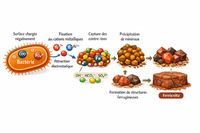
 Reminéralisation d'une phase de carbonate ferreux à partir de la goethite du minerai de fer suite à la bioréduction par Shewanella putrefaciens
 Bacterial iron oxide reduction has been extensively studied over recent decades with the aim of improving knowledge of Fe-bearing mineral transformations. Chemically synthesized Fe(III) oxides such as ferrihydrite or goethite have mainly been used as iron oxide models but very few studies have focused on natural oxides. The scope of our work was to evaluate the ability of iron-reducing bacteria to transform iron ore and to identify the nature and outcome of the reduced phases. For this purpose, Lothringen (Minette), the oolitic iron ore type found in the Lorraine area (North-East of France), was incubated with Shewanella putrefaciens CIP 80.40 as a model iron-reducing bacteria. Chemical and mineralogical analyses (ferrozine assay, X-ray diffraction, diffuse reflectance infrared Fourier transform spectroscopy, Mössbauer spectroscopy, transmission electron microscopy) were performed on both aged (i.e. iron ore oxidized by air during 80 years of mining exploitation) and intact iron ore, before and after bioreduction in anoxic conditions.
 . .
. . L'évolution de l'égalité professionnelle en europe étude comparative
 Pdg Babana Airline
 Jean Durant
 Jean Dupont
 Ingénierie de logiciel
 Gouvernance aires protégées texte
 Prix de l'urbanisme Prix qui récompense les productions de la recherche en urbanisme et aménagement
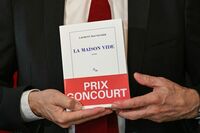 Prix Goncourt
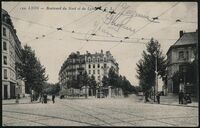 Boulevard du Nord et du Lycée
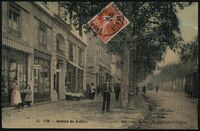 Boulevard des Brotteaux
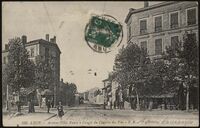 Avenue Félix Faure à l'angle du Chemin des Pins